
The Fourth Update to the Gravitational-Wave Transient Catalogue
Alongside the release of the O4a data on the 26th of August 2025, the LIGO–Virgo–KARGA (LVK) Collaboration published the latest update to the Gravitational-Wave Transient Catalogue (GWTC), bringing the version from 3.0 to 4.0. This update added 128 probable gravitational-wave signals, more than doubling the number observed by the LVK.
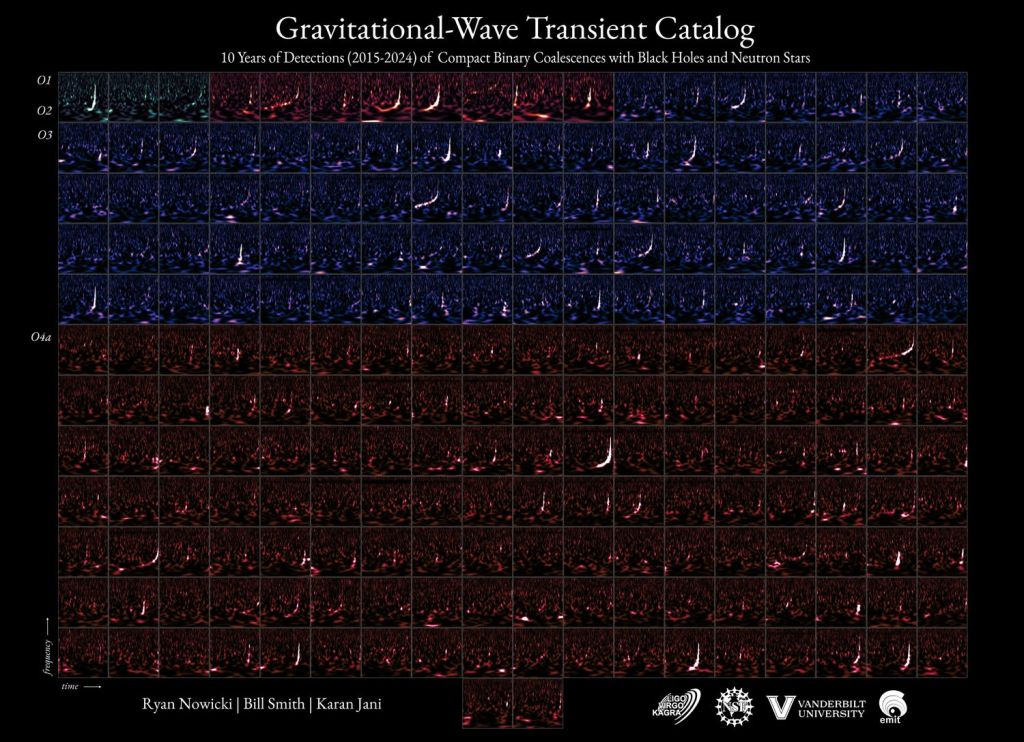
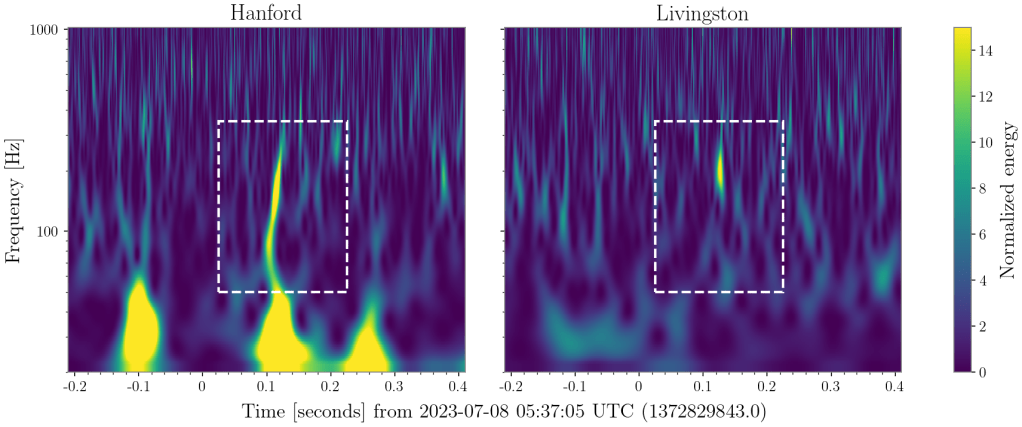
Within the 128 new additions came some LVK record-breakers: from likely the most massive binary system observed, GW231123_135430, to the loudest (signal-to-noise ratio of ~40) detection, GW230814_230901 (since beaten, but still very good). Also included were two candidates thought to be from neutron star-black hole binaries, GW230529_181500 and GW230518_125908, the latter detected during the pre-O4 engineering run. Perhaps the most exciting news for the Gravity Spy project is that of the 128 events, 37 required glitch mitigation, that’s almost 30%! In the case of GW230708_053705 we have a great example of a glitch overlapping in time with a gravitational-wave signal in the Hanford detector.
Following the release of GWTC-4.0, the LVK published papers covering topics such as tests of Einstein’s theory of gravity, known as general relativity, and implications for cosmology, showcasing the science that can be performed with gravitational wave data.
We have lots to look forwards to in future updates to the GWTC as there are many results from O4b, planned to be released in under two weeks, and O4c still to come.
Happy classifying 🕵️♀️,
Elizabeth
For more information about the data release, take a look at this LIGO news article and this recent LVK webinar.
 Gravity Spy