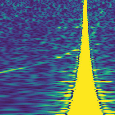
On the 26th May, the LIGO-Virgo-KAGRA Collaboration (LVK) released the fifth update to the Gravitational-Wave Transient Catalogue (GWTC). This update introduces 161 new candidate signals, bringing the total number of probable gravitational-wave candidates to almost 400. Within the catalogue were extra special events: from the loudest gravitational-wave signal detected to date to the best localised event to date and an event that allowed the first informative tests of a technique known as astrophysical calibration, where we can use gravitational-wave signals to tune our detectors.
GWTC-5.0 introduces events detected during the second part of the fourth observing run (04b) which took place for almost 9 months between April 2024 and January 2025. Rejoining the LIGO detectors for O4b was Virgo, after mitigating the instabilities and noise introduced by the installation of a signal recycling mirror during O4a, increasing the bandwidth of the Virgo detector. Between O4a and O4b, the LIGO detectors also underwent upgrades: LIGO Hanford’s coupling of nonlinear noise was reduced by the recommissioning of the main feedback control loop that controls the differential arm length and output loss was reduced by swapping the output mode cleaner with a spare. LIGO Livingston’s end test masses were cleaned, leading to a 15% increase in the gain generated by power-recycling and a 1.6 dB reduction in quantum noise was achieved through adjusting alignment controls. Both LIGO detectors did face problems during the run, with the unexplained glitching of Hanford’s laser and the shutter to protect Livingston’s output mode cleaner failing, both leading to multiple locklosses. These issues were swiftly resolved, however, by the teams at Hanford and Livingston. The upgrades applied to the detectors have led to increases in their sensitivity, and we are now starting to see events with more clarity.

Due to these higher-sensitivity detectors, GWTC-5.0 introduces many loud events, with five of these with signal-to-noise ratios (SNRs) of over 30, louder than the first direct detection of gravitational-waves, GW150914 which was made with an SNR of ~24. The loudest event released in GWTC-5.0, and the loudest detected by the LVK to date, is GW250114, with an SNR of almost 80, almost twice as loud as the previous record-holder. GW250114 was detected almost 10 years after the first direct detection of gravitational waves, GW150914, and is a very similar signal. What’s most impressive, however, is how improvements to detector sensitivity through upgrades have reduced the amount of noise present in the detectors. By seeing events with this much clarity, we are able to perform tests of general relativity: investigating the nature of gravity itself! To do this, we can see if the modes in the ringdown stage of the black hole merger, similar to how a bell rings at a specific tone when it is hit, match up to those predicted by general relativity. While small differences between the observed and expected modes may be observed, they could have been made by deviations from general relativity or from noise such as glitches. With GW250114 being the clearest signal to date, we were able to constrain possible deviations with, in some cases, more precision than when combining 17 events from GWTC-4.0! No clear deviations from general relativity were spotted, so for now the theory holds true.

As well as seeing our signals more clearly, with upgrades and Virgo joining in the search once more, we have been able to narrow down the possible source locations of the gravitational-wave candidates better than ever before. Five of the events released as a part of GWTC-5.0 have sky localisations as least as narrow as the previous most localised event, GW170817. One of these events, GW240615_113620, is localised to just 6 square degrees, beating GW170817’s 16 square degrees by a wide margin, again showcasing the impressive upgrades the detectors have gone through and the importance of multiple gravitational-wave detectors.
Loud and clear signals help us improve our detections, and when they are not calibrated, we can also use them to help our detectors. GW240925_005809 (GW240925 hereafter) was detected when the LIGO Hanford detector wasn’t correctly calibrated. We can think of it as if the detector was out of tune. GW240925 was from a merger of black holes 9 and 7 times the mass of the Sun and it was very loud, with an SNR of over 30, which meant we could perform the first informative tests of a technique called astrophysical calibration: using this signal to tune the Hanford detector so that we can use detector data when they’re not correctly calibrated. Ensuring correct calibration means that we can use and trust data from our detectors when they are not perfectly tuned. While in this case, we were testing astrophysical calibration, and we didn’t need to use it to trust our Hanford data, in the case of GW250207_115645 (detected just after the conclusion of O4b and therefore releasing at a later date), the Hanford detector was so unsettled that without astrophysical calibration, we could not use its data at all!
Another pair of exciting events gave us insights into the formation of binary black holes. GW241011_233834 and GW241110_124123 (GW241011 and GW241110 hereafter) were detected just under a month from each other and showed evidence for the heavier black hole involved in the merger to be highly spinning. When black holes merge, they leave behind a heavier black hole that is rapidly rotating, or spinning. For the heavier black hole in both GW241011 and GW241110 to be highly spinning suggests that they could have been the product of previous mergers, telling us about the history of the black hole pairs in the universe.
With this many detections, it is probably not a surprise that we saw a few coincident with glitches. Almost a quarter of the 161 new additions to the GWTC required glitch mitigation. The eagle-eyed among you that came across subject 103695457 may have spotted something chirp-like in the 4 s view of the glitch. This was, in fact, GW240930_035959 which appeared very close to the koi fish glitch that was uploaded to Gravity Spy.

GWTC-5.0’s 161 new additions showcase the clarity and precision of detections we are now able to achieve with our upgraded gravitational-wave detectors, allowing us to explore the physics behind these events. While GWTC-5.0 does give us plenty of data to play with for now, we can also start to look forward to GWTC-6.0 releasing in December, with yet more exciting events to come!
Happy classifying,
Elizabeth 🕵️♀️
The LVK will be hosting a webinar summarising the GWTC-5.0 introduction, methods and results papers on Thursday, July 9, 2026, at 10:00 AM Eastern US. Click here to register for the webinar and here for the recording when it becomes available.


Leave a Reply