
You might find, like me, that as you get older it seems like the days continue to get shorter (I mean it is already nearly the festive period, where has 2026 gone?). Physics tells us that the opposite is true: the Earth’s rotation is slowing down and each day actually gets slightly longer than the one before. Here I do really mean slightly, this effect amounts to less than 2 milliseconds per 100 years.
Okay, so I can do ~5,000 more 4×4 matrix multiplications on my GPU in a day than I could have 100 years ago (ignoring the glaringly obvious other issues with that thought experiment), how is this likely to impact gravitational-wave science? Well, the issue comes from the fact that while we measure the duration of a day using Earth’s rotation, we measure the duration of a second using the transition of Cesium atoms in the form of an atomic clock. These two measurements of time are called International Atomic Time (TAI) and observed solar time (UT1) and they don’t always agree. The slowing rotation of the Earth and other irregularities* mean that UT1 diverges from TAI and this causes problems e.g. solar noon not agreeing with the noon on your watch. To ensure that TAI and Coordinated Universal Time (UTC) agree to within less than a second, every few years we add a leap-second to UTC. Since the beginning of this practice in 1972, a total of 27 leap seconds have been added to UTC, with the last on 31 December 2016.
While adding** one second doesn’t sound particularly exciting; it has had devastating effects on our modern, computerised world. Leap seconds have been blamed for outages of Linux-based systems such as websites, cloud computing and airline booking systems, especially as some time-distribution systems don’t give much warning, with some only announcing leap-seconds at most 12 hours ahead of time. Further concerns relate to space missions and communication with satellites. All this trouble over one measly second!
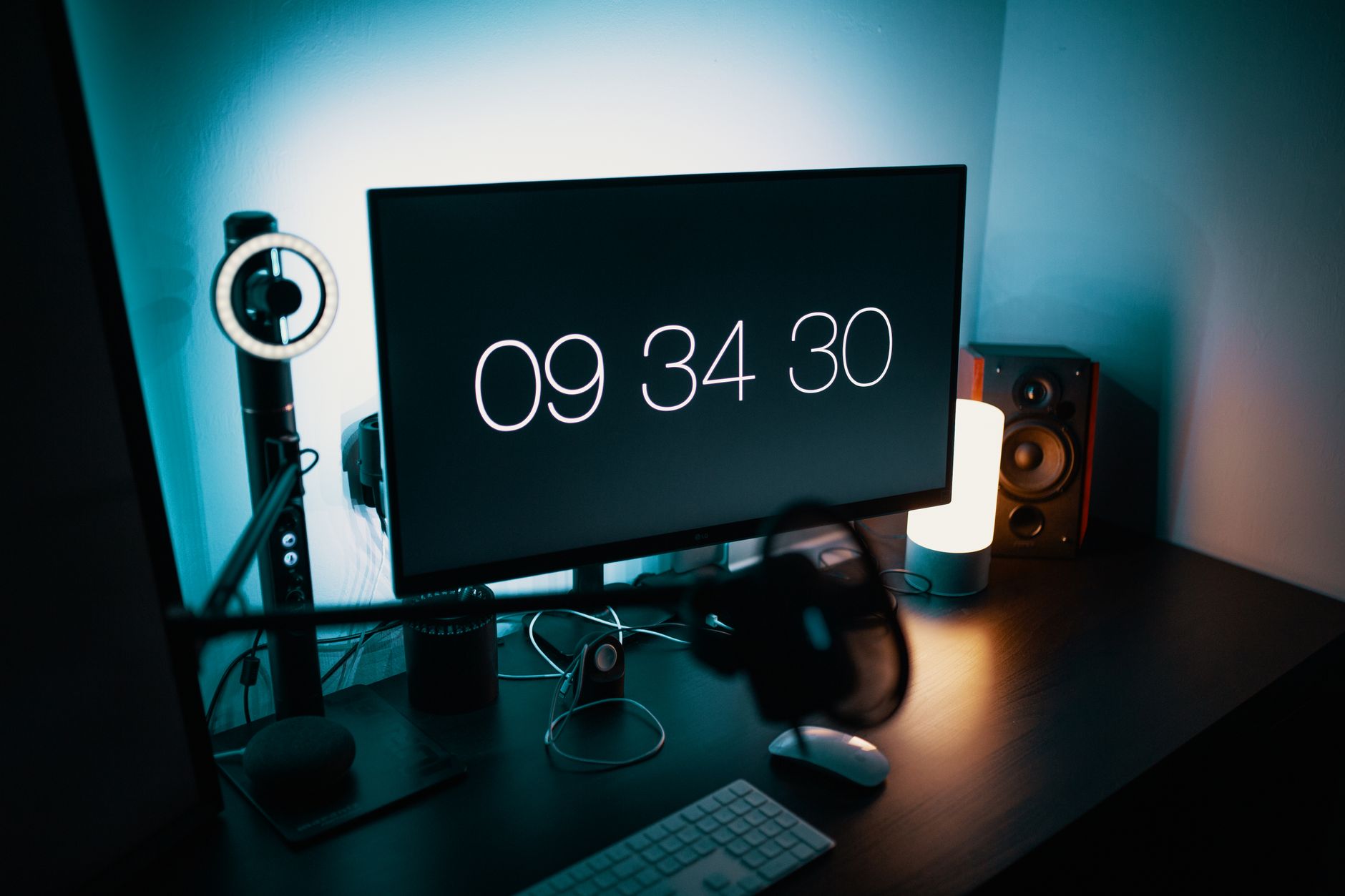
Leap seconds can have devastating effects on computer systems causing crashes and outages. Photo by Josh Sorenson on Pexels.com
Well, the International Bureau of Weights and Measures have had enough, and at the General Conference on Weights and Measures on October 15th, they decided that the leap-second would be no more. From the 20th May 2027 (World Metrology Day/Weights & Measures Day) the threshold of disagreement between UTC and TAI will be raised to one hour instead of the previous one second, though this is not likely to be reached for several centuries.
Okay, so how does all this affect gravitational-wave detectors? During the lifetime of aLIGO, we have only observed one such leap-second (the one back in 2016), but this still has caused its fair share of headaches. This is because the LIGO detectors measure time using a third method: GPS time. GPS time is the time elapsed since midnight UTC on January 6, 1980 (for example when I’m writing this GPS time is 1476665522). GPS time is not particularly simple for us humans to decipher, but it’s very easy for computers to understand, especially as it means not having to deal with a day, month and year (and that different people put those in different orders!). One important thing about GPS time is that it does not observe leap-seconds and so deviates (at the time of writing) from UTC by 18 seconds. Now, to make things even more confusing, while the detectors (and therefore the initial timestamps applied to gravitational-wave data) use GPS time and so don’t account for leap-seconds, when the LVK publishes their results they convert times into UTC, which does! Not only does this affect publications, places that make use of gravitational-wave data such as moderator and volunteer ZngabitanT’s Glitch Plotter have to take this conversion into account when fetching data for plotting Q-transforms.
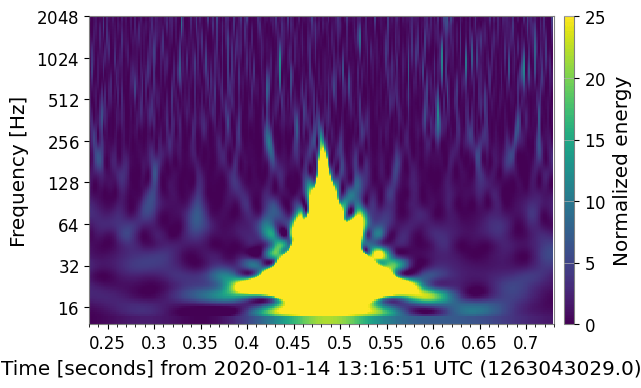
A q-scan of a koi glitch showing both the UTC time and GPS time. If LIGO scientists didn’t account for leap-seconds when converting between the two, they would be off by 18 s, which is a lot when the typical glitch timescale is milliseconds!
With leap-seconds gone (in 2037) the conversion from GPS to UTC will be constant (at least for a few centuries, apologies to future gravitational-wave scientists!) and we will have one less thing to think about when publishing all the exciting research we’ve conducted with our gravitational-wave detectors. I do feel sorry for the computer admins of the future that have to deal with the leap-hour. Will we still be running Linux then…? Probably.
If three different ways of measuring time weren’t enough for you, here are many, many more.
Happy classifying,
Elizabeth 🕵️♀️
*As is often the case with physics, there is more than one phenomena at play here. Climate change, for example, is thought to possibly speed up the rotation, leading to shorter days.
**Negative leap-seconds are possible but have never been imposed. The impact of a negative leap-second on computer systems is one of the main concerns of the International Bureau of Weights and Measures


Leave a Reply